The Stress Loop is a repeatable cycle: a signal triggers a perception, leading to a neural activation and a physical response. This model visualizes that path to help you identify where the cycle can be interrupted.
Educational only; not medical advice.
It starts before you notice it. A threat, thought, or anticipation triggers your nervous system to shift into alert mode. This initial signal sets everything else in motion, even if nothing is “wrong” yet.
The brain interprets the signal and assigns meaning. Past experiences, anxiety, or expectation can turn a neutral cue into a threat. Once labeled, the body prepares to respond.
The brain sends rapid commands through the autonomic nervous system. Heart rate shifts, blood flow changes, and sweat glands activate. This happens instantly and outside conscious control.
The body executes the signal. Sweat glands activate, skin temperature shifts, and muscles tense as part of a broader stress response. Even when the situation doesn’t require it, the body follows through.
Once the response starts, the body notices it. Sweating, heat, or physical discomfort can reinforce the original signal, feeding information back into the brain. This feedback can intensify the loop, even if the trigger has passed
The nervous system either settles or remains on edge. Repeated stress can disrupt recovery, making the loop easier to restart. Calmer regulation helps restore a stable baseline.
The loop above shows how stress turns into sweat.
What varies is how fast you react, how your body handles temperature shifts, and how long recovery takes.
How quickly your nervous system activates when pressure hits.
Fast spikes point to a highly sensitive stress response.
How your body handles heat or cold mismatches.
Sudden shifts often signal stress-driven temperature dysregulation.
How long it takes your system to settle after a spike.
Slower recovery usually means the loop stays active longer.
Neurquel is designed to support these three pressure points so the loop doesn’t stay stuck on repeat.
Once the stress loop is active, blocking sweat alone doesn’t change the signal.
Neurquel is designed to support calmer nervous system regulation at the points where the loop escalates.
Designed to support a more balanced response to incoming stress signals, helping reduce unnecessary amplification before the body reacts.
Supports pathways involved in stress response so the loop is less likely to accelerate once activated.
Helps support the body’s ability to return toward baseline after stress, rather than staying locked in a heightened state.
Stress sweat isn’t just a gland issue. It’s a fast nervous system chain reaction that turns internal pressure into physical output.
A stress signal hits fast. Pressure, anticipation, cold shifts, or social tension activate the system.
The brain evaluates the signal using prediction and threat circuits.
The sympathetic system spikes, sending rapid commands through the body.
Heat shifts, cold sweat, and gland activation follow the nerve signal.
The system takes longer to settle, so sweating continues after the trigger passes.
Incomplete recovery leaves the system primed, making the stress loop easier to restart.
Most sweat treatments focus on blocking the glands. But stress sweat doesn’t start in the glands. It starts in the nervous system, which is why many people still sweat in cold rooms, right after showering, or before anything physical happens.
You’ve just learned why stress-sweat starts in the nervous system.
Neurquel™ is designed to support calmer signaling and balanced responses.
For those who want to verify how their body responds before committing, a limited number of 10-day Early Experience trials are available.
Requests are reviewed individually. Submission does not guarantee access.
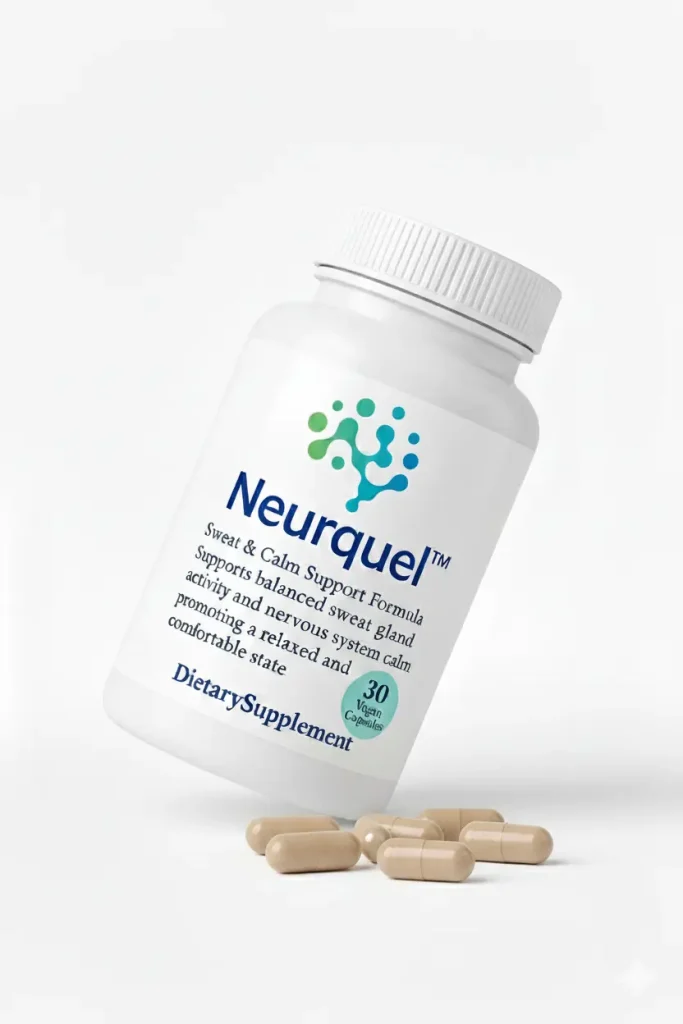
Feel the difference within the first hour.
Get a 10-capsule test pack of Neurquel™ and see how your body responds.